
Ultra-fast PII detection inside your infrastructure
Voidwall is a self-hosted HTTP proxy and API that detects PII across HTTP, API, and AI traffic.
- Predictable infrastructure costs
- Single-digit millisecond latency (P99)
- Scales to thousands of PII types
- Add custom PII types without retraining models
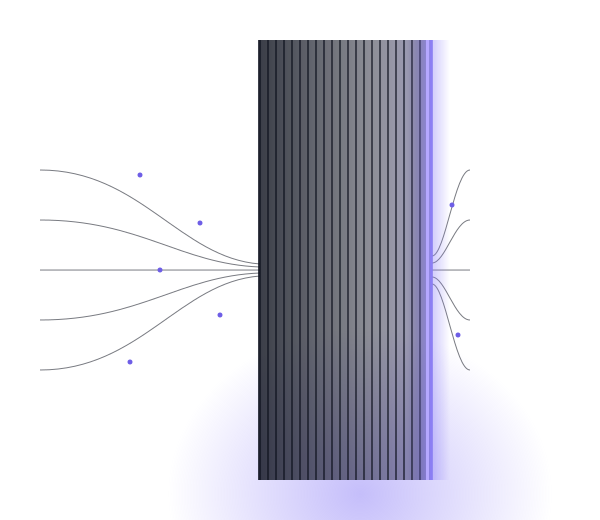

What Voidwall does
Run it two ways: inline as an HTTP proxy that filters live traffic, or as a REST API you call to scan and redact on demand. The tag on each card shows where it applies.
Scan
Proxy + APIParse and scan every outgoing payload across JSON, CSV, TSV, and plain text.
Redact
Proxy + APIReplace detected PII with placeholders like [EMAIL], [US_SSN], [FR_NIR]...
Mask
Proxy + API...or mask with configurable characters.
Block
Proxy onlyBlock the entire request if contains sensitive data.
Alert
Proxy onlyWarn when sensitive data leak is detected.
Detection coverage
118 PII types.
And growing.
Voidwall is able to detect PII using pattern recognition, contextual analysis and validation, so it warns about real values, not just looks-like ones. Here are examples of what can be detected.
Custom types can be added via configuration file.
Identity & Contact
National IDs
Travel & Driving
Health & Tax
Financial & Crypto
Tech & Secrets
Analytics, sanitized
Scan GA4 and Matomo
traffic in real time.
Front-end tracking is the leakiest path out of a product - marketing teams add events, users paste their PII to search bars, and personal data slips into Google or Matomo unnoticed. Even 20% of websites have this problem. Voidwall may be a proxy between your product and web analytics, preventing your users' personal data from leaking out.
Specializations know what to scan - catching sensitive data even inside doubly-encoded payloads. They also know what not to scan, so the integration keeps working as intended.
Format-aware
Works well even with nested data.
Voidwall parses the request before it scans it. Whether the payload is a nested JSON, a flat CSV, a tab-separated data, a URL packed with query parameters, or free-form text, the same matchers apply.
Performance
Built for the
edge of your stack.
Voidwall scales horizontally, runs in your cluster, and adds a budget you can measure in single-digit milliseconds. It's designed to be a lightweight, self-hosted service that doesn't break the bank as you grow.
added per request, payload size 10 KiB
single container, 6 logical cores, 10 KiB payload
single container, 6 logical cores, 10 KiB payload
Horizontal scaling
Stateless by design. No shared database, no coordination between containers, no dependencies to provision first.
Ships as a single container
Pull the image and go. Runs entirely in your environment. No payloads leave your infrastructure.
Proxy or API - your call
Drop it inline as a reverse or forward proxy, or call the HTTP API to scan and redact on demand. Same engine, three ways to plug in.
From the blog
Notes from the wall.
Measuring Voidwall’s PII Detection Effectiveness
How well does Voidwall actually detect PII? We measure precision and recall on a curated English AI4Privacy dataset, broken down by category and data structure.
Understanding PII Detection Effectiveness
Evaluating PII detection tools may seem straightforward, but choosing the right tool requires understanding the nuances behind the metrics.
Sensitive Data Is Easier to Control Before It Spreads
Sensitive-data leaks are not just exposure, they are propagation events: once sensitive data enters modern infrastructure, deleting it becomes a distributed-systems problem.
By subscribing you agree to our Privacy Policy.